[tintuc]

Bối cảnh và nhu cầu thực tiễn

Trong các ngành công nghiệp như khai thác khoáng sản, nhiệt điện, xi măng và luyện kim, hiện tượng mài mòn và ăn mòn luôn là một trong những nguyên nhân chính gây suy giảm hiệu suất thiết bị. Các khu vực như hệ thống nghiền, vận chuyển vật liệu, cyclone, đường ống slurry hay chute thường xuyên phải làm việc trong môi trường khắc nghiệt với tải trọng lớn, vật liệu có độ cứng cao và tốc độ dòng chảy lớn.

Hệ quả là chi phí bảo trì tăng cao, thời gian dừng máy kéo dài và tuổi thọ thiết bị bị rút ngắn đáng kể. Điều này đặt ra yêu cầu cấp thiết về các giải pháp vật liệu và công nghệ chống mài mòn hiệu quả hơn, linh hoạt hơn so với các phương pháp truyền thống.

Tổng quan các công nghệ chống mài mòn hiện nay

Hiện nay, các giải pháp phổ biến bao gồm:

  • Tấm chống mài mòn hàn đắp sử dụng dây lõi thuốc (flux-cored wire)
  • Vật liệu đúc hợp kim chịu mài mòn cao
  • Tấm lót ceramic hoặc composite
  • Hàn đắp phục hồi trực tiếp tại hiện trường

Trong đó, công nghệ hàn đắp bằng dây lõi thuốc được sử dụng rộng rãi nhờ tính linh hoạt và khả năng tạo lớp phủ cứng. Tuy nhiên, phương pháp này vẫn tồn tại một số hạn chế:

  • Thành phần hợp kim bị giới hạn bởi cấu trúc dây lõi
  • Khả năng tùy biến theo điều kiện làm việc chưa cao
  • Khó kiểm soát hoàn toàn cấu trúc vi kim và phân bố pha cứng
  • Chi phí vật tư tương đối cao

Công nghệ POP – Nguyên lý và cấu trúc hệ thống

Công nghệ POP (Powder Overlay Process) là một hướng phát triển mới trong lĩnh vực hàn đắp chống mài mòn, kết hợp giữa bột hợp kim thiết kế theo yêu cầu và dây hàn đặc, vận hành trên hệ thống hàn được kiểm soát chặt chẽ.

Về nguyên lý, thay vì sử dụng dây lõi thuốc, lớp phủ chống mài mòn được hình thành thông qua:

  • Cấp liệu hỗn hợp bột hợp kim với thành phần được thiết kế riêng
  • Kết hợp với nguồn nhiệt từ hồ quang của dây hàn đặc
  • Quá trình nóng chảy – đông đặc được kiểm soát chính xác

Hệ thống POP thường bao gồm:

  • Cơ cấu cấp bột hợp kim chính xác
  • Nguồn hàn và đầu hàn được thiết kế riêng
  • Hệ điều khiển thông số (dòng, áp, tốc độ cấp liệu, tốc độ dịch chuyển)
  • Bàn hàn và hệ thống cơ khí đảm bảo độ ổn định

Ưu điểm nổi bật của công nghệ POP

Tùy biến thành phần vật liệu

Ưu điểm lớn nhất của POP là khả năng thiết kế thành phần hợp kim theo yêu cầu, phù hợp với từng loại môi trường làm việc và tác nhân gây mòn khác nhau. Thông qua việc điều chỉnh công thức bột, có thể:

  • Tăng hàm lượng carbide (Cr, Nb, W, v.v.)
  • Tối ưu cấu trúc vi kim cho từng môi trường làm việc
  • Kết hợp khả năng chống lại nhiều tác nhân gây mòn, như: bào mòn (abrasion), ăn mòn (corrosion), xói mòn (erosion)....

Điều này đặc biệt hữu ích với các môi trường đặc thù như:

  • Slurry trong tuyển khoáng
  • Tro bay trong nhà máy nhiệt điện
  • Clinker trong ngành xi măng

Kiểm soát chất lượng lớp phủ

Do hệ thống được thiết kế đồng bộ, các thông số hàn được kiểm soát chặt chẽ, giúp:

  • Đảm bảo độ đồng đều của lớp phủ
  • Kiểm soát độ dày và độ pha loãng (dilution)
  • Giảm khuyết tật như nứt, rỗ khí

Tối ưu chi phí sản xuất

So với dây lõi thuốc, việc sử dụng bột hợp kim và dây hàn đặc giúp:

  • Giảm chi phí vật tư
  • Tăng hiệu suất sử dụng vật liệu
  • Linh hoạt trong lựa chọn nguồn nguyên liệu

Nâng cao tuổi thọ thiết bị

Nhờ khả năng tối ưu cấu trúc vật liệu, lớp phủ POP có thể:

  • Tăng khả năng chống mài mòn trượt và va đập
  • Cải thiện độ bền trong môi trường kết hợp mài mòn – ăn mòn
  • Kéo dài chu kỳ bảo trì

Ứng dụng trong công nghiệp

Công nghệ POP có thể được ứng dụng rộng rãi trong nhiều lĩnh vực:

  • Ngành khai thác và tuyển khoáng: cyclone, ống dẫn slurry, bơm, chute
  • Ngành xi măng: con lăn nghiền, bàn nghiền, máng dẫn clinker
  • Ngành nhiệt điện: ống dẫn tro, quạt, thiết bị vận chuyển than
  • Ngành luyện kim: máng rót, thiết bị xử lý vật liệu nóng

Ngoài sản xuất tấm chống mài mòn, D-Plate, công nghệ POP còn có thể áp dụng trong:

  • Gia công chi tiết chống mài mòn theo yêu cầu
  • Phục hồi thiết bị đã bị mòn

Xu hướng phát triển và tiềm năng ứng dụng

Trong bối cảnh các ngành công nghiệp ngày càng yêu cầu cao về hiệu suất và tối ưu chi phí, các công nghệ có khả năng tùy biến vật liệu và kiểm soát quá trình như POP sẽ ngày càng đóng vai trò quan trọng.

Đặc biệt, với xu hướng chuyển từ “thay thế” sang “kéo dài vòng đời thiết bị”, các giải pháp như POP không chỉ giúp giảm chi phí mà còn góp phần nâng cao tính bền vững trong sản xuất công nghiệp.

Kết luận

Công nghệ POP (Powder Overlay Process) đại diện cho một bước tiến đáng kể trong lĩnh vực chống mài mòn, nhờ khả năng kết hợp linh hoạt giữa thiết kế vật liệu và kiểm soát quá trình hàn.

Với những ưu điểm về tùy biến, chất lượng và chi phí, POP hứa hẹn sẽ trở thành một trong những giải pháp chủ đạo cho các ngành công nghiệp nặng trong thời gian tới.


 Tải về file giới thiệu BCC D-Plate[/tintuc]

   [tintuc]

🔥 Laser Cladding – Giải pháp tối ưu tuổi thọ thiết bị công nghiệp

Trong các ngành như xi măng, khai khoáng, nhiệt điện, sản xuất thép, giấy, hóa chất, mài mòn và ăn mòn là nguyên nhân chính làm giảm hiệu suất và tăng chi phí vận hành.

Laser Cladding (đắp phủ bằng laser) là công nghệ tiên tiến giúp:

  • Phục hồi chi tiết bị mòn
  • Gia cường bề mặt
  • Tăng tuổi thọ thiết bị lên 2–5 lần

👉 BCC LaTech cung cấp dịch vụ Laser Cladding chuyên sâu, giúp doanh nghiệp giảm downtime và tối ưu chi phí dài hạn.

⚙️ Laser Cladding là gì?

Laser Cladding là quá trình:

  • Sử dụng tia laser công suất cao tạo bể nóng chảy
  • Đồng thời cấp bột kim loại vào vùng này
  • Hình thành lớp phủ liên kết luyện kim với vật liệu nền

👉 Khác với hàn hay phun phủ:

  • Không bong tróc
  • Độ bền cao hơn
  • Kiểm soát chính xác hơn

💡 Ưu điểm của công nghệ Laser Cladding

🔩 Độ bền vượt trội

  • Liên kết luyện kim
  • Không bong lớp

🎯 Độ chính xác cao

  • Vùng ảnh hưởng nhiệt nhỏ
  • Không biến dạng chi tiết

⛏️ Chống mài mòn & ăn mòn mạnh

  • Phù hợp môi trường khắc nghiệt

💰 Giảm chi phí vận hành

  • Ít thay thế
  • Giảm thời gian dừng máy

🏭 Ứng dụng Laser Cladding

Dịch vụ BCC LaTech được ứng dụng rộng rãi:

  • Thiết bị ngành xi măng (roller, bàn nghiền)
  • Thiết bị khai khoáng (chute, screw, pump)
  • Thiết bị ngành điện (boiler, turbine)
  • Nhà máy thép (caster rolls)
  • Thiết bị hàng hải
  • Trục, bơm, chi tiết cơ khí

👉 Phù hợp với mọi chi tiết chịu:

  • Mài mòn
  • Ăn mòn
  • Nhiệt độ cao

🧪 Vật liệu phủ Laser Cladding

BCC LaTech sử dụng đa dạng vật liệu:

  • Tungsten Carbide (WC): chống mài mòn cực cao
  • Ni-based alloy: chống ăn mòn, chịu nhiệt
  • Co-based alloy: chịu va đập + nhiệt
  • Fe-based alloy: giải pháp kinh tế

👉 Lựa chọn vật liệu theo đúng cơ chế hư hỏng

🔄 Quy trình dịch vụ Laser Cladding tại BCC

  1. Khảo sát & phân tích hư hỏng
  2. Chuẩn bị bề mặt
  3. Đắp phủ Laser
  4. Gia công hoàn thiện
  5. Kiểm tra chất lượng

👉 Đảm bảo độ chính xác và độ bền cao

🏢 Vì sao chọn BCC LaTech?

  • 🔬 Có trung tâm R&D riêng
  • 🏭 Hệ sinh thái sản xuất hoàn chỉnh
  • 👨‍🔧 Đội ngũ kỹ sư và thợ lành nghề
  • ⚙️ Trang thiết bị hiện đại 

👉 Không chỉ cung cấp dịch vụ – BCC cung cấp giải pháp toàn diện


 Tải về file giới thiệu dịch vụ BCC LaTech Services

[/tintuc]

[tintuc] The fourth Industrial Revolution (Industry 4.0) is changing the way products are created by spreading digitized manufacturing/processing and automation. We have seen the benefits of automation over decades and are now adding enhanced data, machine learning and artificial intelligence to the mix. Today, autonomous systems are more interconnected, communicating, analyzing and interpreting data to let managers intelligently decide and act in other areas of the factory.

Smart factory initiatives create business value by increasing output, asset utilization and productivity. They leverage new data streams to improve flexibility and quality while reducing energy consumption and  waste. Increasingly, edge-to-cloud connected networks let factories increase efficiency through mass customization.

The goal of Industry 4.0, much like IIoT, is to increase the amount of usable data and improve decision making. Timely access to data and its delivery depends on networks. Networking technology, along with manufacturing processes and methods, must advance to handle more dataIntelligent, interconnected automation requires connected machines collecting and sharing information. How these machines and factory communicate through networks makes Industry 4.0 possible.

The need for seamless connectivity from every sensor and actuator across the factory, even those in remote locations, is impossible within the existing infrastructure. The challenge is finding how to handle unprecedented volumes of data without crippling the communication network designed to transmit it. This raises the question of how to build and deploy industrial communication networks to meet the needs of today’s automation environments and tomorrow’s virtual factory floors.

Why Deploy Industrial Ethernet?

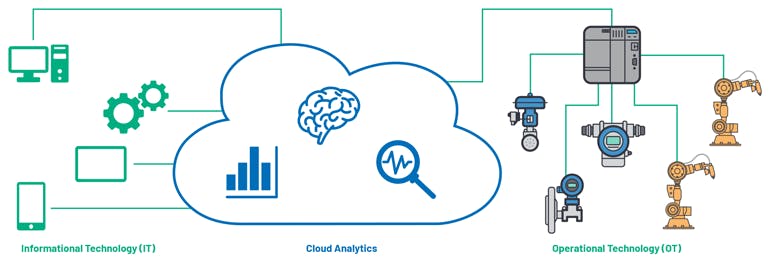
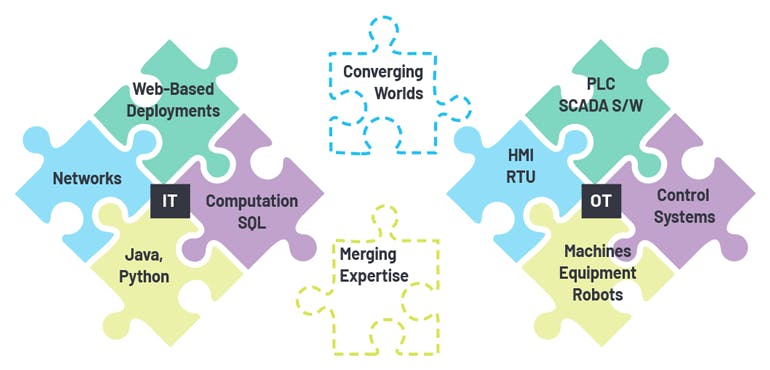
Connectivity is central to Industry 4.0, but three things must happen before there are truly connected companies. First, higher-level information technology (IT or enterprise infrastructure) must merge with the plant floor operational technology (OT and the control network). Secondly, manufacturing cells on factory floors must interoperate. Thirdly, there must be seamless, secure connections from the edge of the process to the cloud.

To address these challenges, industry must adopt networks that support interoperability, expandability and reach. Ethernet seems ideal, being well understood and widely used in most factories. It also has high bandwidth and can be put in place relatively quickly.


However, Ethernet is not suited for industrial control given the need for real-time operations. Control networks must send information where and when it is needed to ensure the tasks are processed correctly. The TCP/IP protocol for routing traffic does not guarantee this level of performance. In the same way standard Ethernet lets users share files and access network devices such as printers, Industrial Ethernet lets controllers access data and send instructions from PLCs to sensors, actuators and robots on the factory floor.

The key difference between the two is the impact of delayed and undelivered messages. In non-real-time applications, if the webpage updates too slowlyeffects are minimal. In manufacturing environments, however, effects can be more harmful—from wasting materials to injuring workers. For control systems to work, messages must get to their destinations reliably and on time, every time.

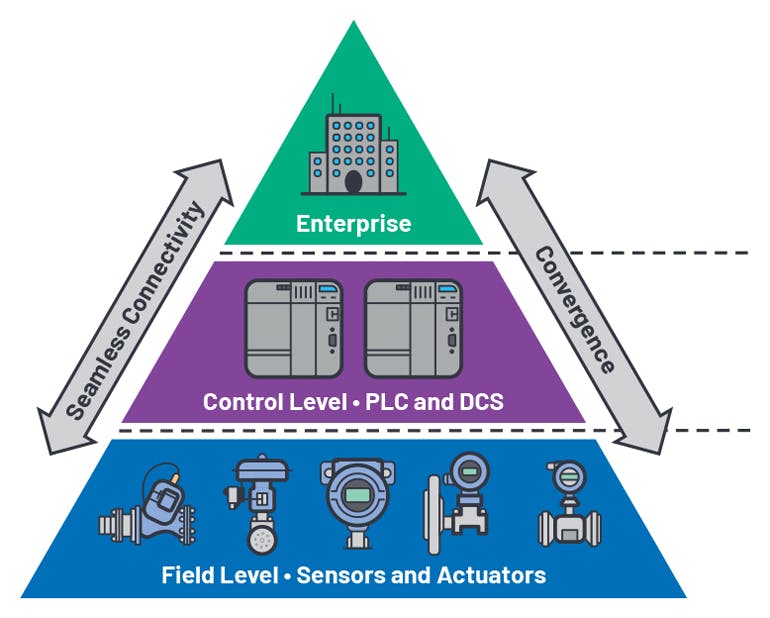
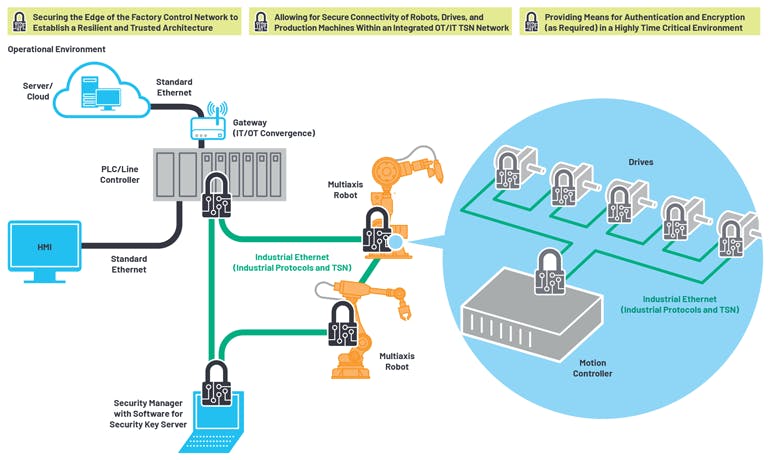
As a result, Industrial Ethernet has emerged as the technology of choice at the control level of the operating technology. The goal is to connect IT and high-level operation networks, as well as connecting the layers of the factory’s operations network to end-node sensors and actuators (see illustration below).

Today, complex, power-hungry gateways are required to connect manufacturing cells to Ethernet at higher layers where the converged IT/operational technologies are required. Having plant-wide, interoperable automation network based on Ethernet would eliminate the need for these gateways, thereby simplifying the network.

In fact, protocol gateways that translate and connect to the operational network’s upper layer are not directly addressable and create information isolation within the network. This data isolation limits the ability to share information across the factory . This is contrary to a vision of Industry 4.0 in which manufacturers want to collect telemetry data from the operational side to drive analytics and business processes on the IT side.

Control applications need predictability in packet delivery and timing guarantees. So, many vendors tried to provide real-time protocols for operational networks. This resulted in solutions that, while predictable, were specific to each vendors’ protocol. This, in turn, led to lots of different incompatible communication protocols running in different manufacturing cells. This perpetuates data isolation, or data islands. Different manufacturing cells running different protocols must share the network in a way that guarantees control traffic is not compromised.

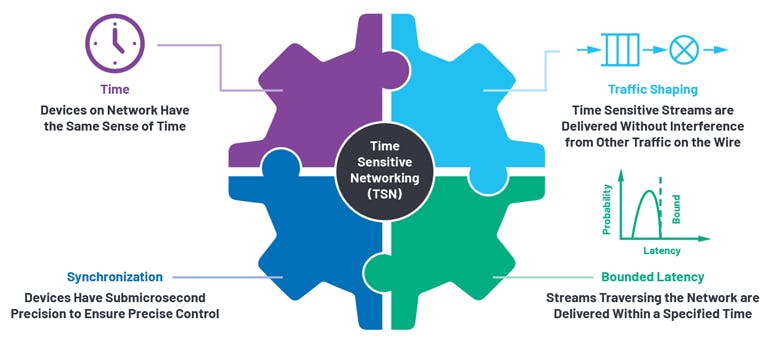
The answer is time sensitive networking (TSN)a vendor-neutral, real-time Ethernet standard based on the IEEE 802.1. As the name implies, TSN focuses on time. It transforms standard Ethernet communication into a process that guarantees timing for mission-critical applications. It makes sure information moves from one point to another in a fixed and predictable amount of time. This is how TSN guarantees timely delivery.

For communications to be predictable, network devices must share a concept of time. The standard defines how to transmit certain TSN Ethernet frames on a schedule, while letting non-TSN frames be transmitted on a best-effort basis. This is how TSN handles real- and non-real-time traffic on the same network. All devices share the same time, so data can be transmitted with low latency and jitter at gigabit speeds.

The goal is a converged network, where protocols each share the wire predictably and reliably. TSN’s tools provide the predictability. It represents the transition to a reliable and standardized connectivity architecture, eliminating data isolation through proprietary fieldbuses. This convergence of networks will drive data generation through the network’s growing scalability across bandwidths from 10 Mbps to 1 Gbps and beyond.

The likely scenario is that TSN will be adopted throughout new installations, but incrementally in cells or segments within facilities. For field-device manufacturers, this means Industrial Ethernet and TSN must be supported for the foreseeable future.

Connecting the Entire Enterprise

Our final and perhaps most important change is building seamless connectivity from the edge node to the enterprise cloud in process control applications (see graphic below).

To date, connectivity to the edge has been limited by the 4-mA to 20-mA or fieldbus technologies. These hardwired point-to-point connections restrict the network ‘s flexibility to grow and change over time.

These non-Ethernet-based communications face several challenges. First, bandwidth such as 1.2 kbps for HART on 4-mA to 20-mA limits information flow’s amount and speed. Second, limited power delivery to the instrument restricts is functionalityFinally, the gateways at the control and IT level are an unsustainable overhead. There is also the challenge of operating in intrinsically safe Zone 0 and using existing cabling network to support faster, less-expensive commissioning.

These challenges necessitated development of IEEE 802.3cg-2019, a standard for 10BASE-T1L, full-duplex communication. It was recently approved and specifies 10 Mbps full-duplex communication with power over a single twisted-pair cable up to 1-km long.

Data starts in the sensor as an Ethernet packet and goes to the operational network and IT infrastructure as an Ethernet packet. There is nneed for translation, which creates delays and costs, and consumes power. Existing networks will change, with remote I/O units going to Ethernet field switches.

Ethernet instructions can be sent to and from the controller through 10BASE-T1L multiport field switches to and from field instruments. Insights generated at field nodes can be sent via Ethernet packets (with higher bandwidth) through the field switch network to PLC/DCS controllers and, ultimately, to the cloud.

Several advantages will drive the move from legacy fieldbuses to Industrial Ethernet. First, the potential to reuse existing cabling (up to 1 km in lengthsimplifies deployment and reduces retrofitting costs. Second, power delivered over the cable to the equipment was confined to 36 mW (best case, with 4 mA to 20 mA deployments). It will be free to go up to 60 W (cable dependentor 500 mW in Zone 0 applications.

The extra power lets equipment handle higher functions with end node intelligence. This, and the 10 Mbit uplink speed now available, will provide increased insights in how to capitalize on Industry 4.0’s promised efficiencies.

What’s Available Now?

Durable, low-latency, low-power equipment with scalable switching is needed for automation networks to advance. To support next-generation applications, Industrial Ethernet-manufacturers are developing silicon and software to ensure time-critical data is reliably delivered throughout industrial applications. For example, ADI Chronus from Analog Devices provides embedded switches and multiprotocol software that are fully tested and verified for fast times to market.

  • Notable solutions within Chronous include: 10 Mbps/100 Mbps Industrial Ethernet PHY with improved features and durability.
  • The lowest latency, lowest power gigabit PHY that withstands harsh environments. The fido5200/fido5100 a real-time, embedded, two-port, multiprotocol switch that supports many TSN features.
  • New TSN features can be added via firmware updates that become available. Multiprotocol software updates are also supported and available through the developer’s portal.

To support the transition and provide a bridge to legacy field devices, a software configurable I/O (AD74413R) from Analog Devices lets users develop field-configurable remote I/O units that handle communications between legacy machines and higher- level Ethernet networks.

What About Security?

Ethernet has vulnerabilities, and security is a critical one that is slowing adoption of Industry 4.0. With an open flow of an enterprise’s information between operational networks and IT and from the edge to the cloud, the aftermath of security breaches could be devastating.

Security should be a fundamental risk-management concern in planning an Industry 4.0 strategy. Building security into increasingly complex networks is not easy. It must be a multilayer approach that makes its way through the entire system—within edge devices, controllers, gateways and further up the stack. With silicon and software becoming available, OEMs can offer security at each node point in the system while minimizing trade-offs in power, performance and latency.

The Roadmap to Deployment

Although Industrial Ethernet has seen considerable growth in recent years, fieldbuses and other legacy networking technologies are still being deployed. The advantages of converged networks based on Industrial Ethernet include a simplified network architecture, cost reduction by removing gateways, improving system optimization and increasing up-time. The advent of new standards and their imminent ratification is the catalyst needed to accelerate this awaited transition.

This is a transition firmly driven by the need for better-performing connectivity networks with increased integration between OT and IT. TSN is the vehicle to deliver a converged network and, when married with 10BASE-T1L, will enable seamless edge-to-cloud connectivity. The migration will not happen overnight, but the potential benefits are so compelling that it is likely adoption will outpace standard industrial norms.

At the heart of the Industry 4.0 vision is the ability to automate processes using connected devices with the capacity to collect, send and receive information. New technology is unlocking the data and insights previously unobtainable from many edge-node devices. It is opening the doors to better data analysis and operation insights. Industrial Ethernet connectivity will awaken this reality through the seamless transfer of current and future data streams across the automation network to the cloud.

There are data islands of information and insight we cannot access today, but as Industrial Ethernet deployment becomes the norm, the challenge for Industry 4.0 will move to security and what to do with all this data to maximize our business value.

[/tintuc]

Sản phẩm và Dịch vụ

BCC tập trung phát triển, và cung cấp các giải pháp chống mòn và gia cường tuổi bền mòn chi tiết công nghiệp sử dụng công nghệ hàn đắp bề mặt. Để tìm hiểu về sản phẩm và dịch vụ của chúng tôi, xin mời tìm ở các link thông tin phía dưới đây

giới thiệu

BCC Techlogoies là trung tâm nghiên cứu và phát triển công nghệ trực thuộc BCC. Sự ra đời của BCCTech là sự hợp tác giữa nền tảng sản xuất của BCC và các nhà khoa học thuộc ĐHBK Hà Nôi và ĐHSPKT Nam Định. Tại BCCTech, chúng thực hiện các công việc:
  • Nghiên cứu phát triển các giải pháp trên nên tảng Công nghệ POP
  • Nghiên cứu phát triển các giải pháp thông minh hóa quá trình sản xuất
Chi tiết về BCC tại đây

Video

-->
0898-47-1122